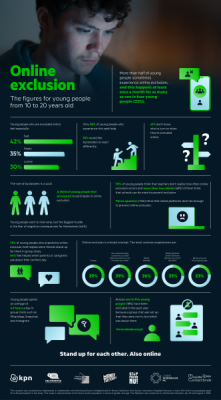
One in four young people is excluded online every month
Singer S10, with her new song ‘Home Free’, calls on bystanders: Stand up for each other. Also online
A quarter of young people (23%) are excluded online at least once a month, according to new research by Helpwanted. This growing problem, which mainly takes place in group chats, can lead to serious psychological consequences. To raise awareness, Dutch singer S10 today releases her new song ‘Home Free’, ahead of the Dutch Week Against Bullying. The song, together with an accompanying film, highlights the impact of online exclusion and calls on all bystanders: Stand up for each other. Also online. This initiative is a collaboration between S10 and telecomprovider KPN, supported by Stichting School & Veiligheid, Helpwanted, Stop Pesten Nu, De Kindertelefoon and Dr. Remco Spithoven.
Home Free against online exclusion
Young people are spending more and more time in group chats such as Snapchat, WhatsApp and Instagram, on average around 4.1 hours a day. As a result, online exclusion is becoming increasingly common; a form of bullying where someone is deliberately ignored, blocked, or removed online. The song ‘Home Free’, which also serves as the soundtrack to the short film ‘Iedereen Behalve’ (‘Everyone Except’), captures the impact of online exclusion and the role bystanders play. “My song Home Free reflects the loneliness and sadness caused by the pressure the digital world can put on young people,” says S10. “When people turn against you online, it can feel endless, as if it will never stop. At those times, I wish I could just say ‘home free,’ so I wouldn’t have to keep hiding. And to the bystanders: with even the smallest gesture, anyone can bring a little light into someone else’s life. One message, one comment, one bystander speaking up… that can make all the difference.”
Social isolation and depression caused by online exclusion
New research by Helpwanted, in collaboration with School & Veiligheid and Dr. Remco Spithoven from Saxion University of Applied Sciences, shows how widespread the issue is among young people aged 10 to 20: more than half have experienced being excluded online at some point, and as many as one in four (23%) face it at least once a month. Online exclusion can lead to serious psychological effects such as insomnia, social isolation, and depressive feelings. Young people who are excluded online report feeling mainly sad (42%), angry (35%), and lonely (30%). About a quarter (25%) regularly feel depressed or down because of online exclusion. “These figures highlight how group chats, as a social environment, have a huge impact on young people’s wellbeing,” says Rivka Otten of Helpwanted, a helpline for online transgressive behavior. “It is alarming that young people feel so lonely after being excluded online, yet only a small percentage receive help. It is essential to encourage them to break through group behavior and speak up as soon as they see something that isn’t okay. The message is clear: Stand up for each other. Also online.”
Peer pressure is strong for bystanders
The role of bystanders is crucial. A third of young people (33%) have at some point felt pressured to join in with online exclusion. While many want to intervene, the biggest barrier is fear of negative consequences for themselves (64%). Dr. Remco Spithoven, social scientist and professor of Online Resilience at Saxion University of Applied Sciences, explains: “Young people are in a stage of life where social validation is extremely important. This makes them more vulnerable to peer pressure. That’s precisely why we need to equip them with the skills to recognize this pressure and to turn it into something positive.”
The Week Against Bullying: an opportunity for dialogue
“The research shows that young people believe adults underestimate the seriousness of the problem,” says Marijke van der Zalm of School & Veiligheid. “69% of young people report that teachers are unaware of how often online exclusion occurs, and 68% believe that schools should do more to prevent it. That’s why, during the Week Against Bullying, taking place from 22 to 26 September, School & Veiligheid together with KPN will offer an interactive module that shows young people the moments in which they, as bystanders, can make a difference.”
How was your day online?
This initiative was made possible with the support of KPN and is backed by Helpwanted, School & Veiligheid, Stop Pesten Nu, De Kindertelefoon and Dr. Remco Spithoven. The song ‘Home Free’ and the film ‘Iedereen Behalve’ (‘Everyone Except’) are part of a broader campaign aimed at starting the conversation about online exclusion and raising awareness among young people, parents, and teachers about both its impact and the responsibility of bystanders. As part of its mission to make the internet better, KPN is committed to creating a safer, more social, and greener online world. Following last year’s campaign with MEAU about online shaming, KPN is now focusing on online exclusion. Because the internet should be a place that connects and empowers people, not one that excludes or divides. With these initiatives, KPN wants to spark conversations, also at home. So that parents don’t just ask how school was, but also: “How was your day online?”
For more information see www.kpn.com/iedereen-behalve